
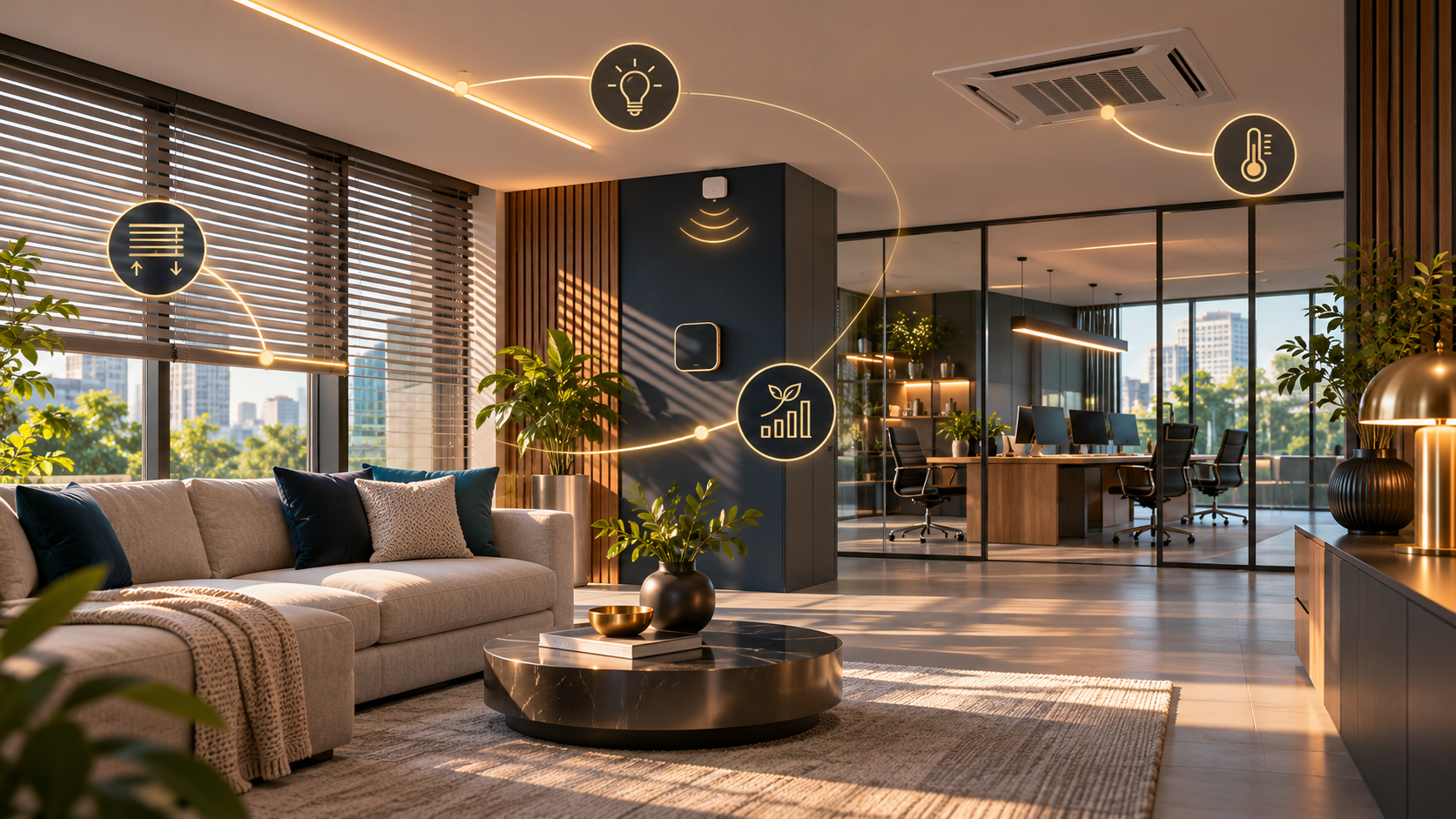
A Building Management System, or BMS, can supervise and automate several systems through a common logic. Although often associated with large buildings, it can also create value in houses, apartments, offices and commercial spaces when sized for real needs.
Consistent comfort
Lighting, temperature, blinds and ventilation can adapt to schedules, occupancy and outdoor conditions. Instead of independent controls, users have simple scenarios such as arrival, work, away or night. Automation reduces repetitive tasks without removing manual control.
Energy efficiency
The system helps prevent lights remaining on in empty areas, climate systems operating with open windows, or equipment running outside working hours. Metering and history make consumption visible and help identify deviations. Savings come from combining data, appropriate rules and continuous follow-up.
Safety and prevention
Technical alarms for water leaks, temperature, smoke or power failure can trigger automatic actions and notifications. Integration with access control, video surveillance or intrusion systems should be planned with security and privacy in mind.
Simpler operation
In an office, BMS centralises schedules, status and alarms, supporting maintenance. In a home, a clear interface controls the main systems without multiple applications. Remote access should be protected and limited to what is necessary.
Ready to evolve
An open and documented architecture makes it possible to add zones, sensors or new functions without rebuilding the entire system. Project quality, electrical panels, networking and programming are as important as the selected equipment.
Diagnosis comes first
Before automating, understand how the space is used, which problems exist and what outcomes are expected. Not everything should be automated. A good BMS makes technology discreet, predictable and useful, with measurable benefits for those who live, work in or manage the building.